
One of the first questions business owners ask after starting SEO is:
“How long does SEO take to work?”
The honest answer is that there is no fixed timeline for every website.
Some websites start showing early changes within weeks. Others take several months before they see strong growth in rankings, organic traffic, or leads.
Google also explains that crawling and indexing can take time, and that there is no secret method that automatically puts a website at the top of Search.
So what should a business actually expect?
Let’s make it simple.
What Does SEO Actually Mean?
SEO stands for Search Engine Optimisation.
It is the process of improving your website so search engines can better understand your pages and users can find your business through relevant searches.
SEO can include:
- Improving website structure
- Fixing technical issues
- Optimising pages
- Creating useful content
- Improving internal links
- Building relevant authority
- Improving local search visibility
SEO is not just about adding keywords to a page.
Google’s SEO guidance focuses on helping search engines understand your content while making it useful and accessible for people.
So, How Long Does SEO Take?
There is no universal answer.
A commonly cited industry benchmark is around 3–6 months for measurable progress, while competitive websites and markets can take longer. Search Engine Land’s 2026 SEO guide similarly describes three to six months as a typical period for measurable results, with more competitive situations sometimes taking longer.
But the important point is this:
SEO results do not suddenly appear on one particular day.
SEO is usually a gradual process.
You may see:
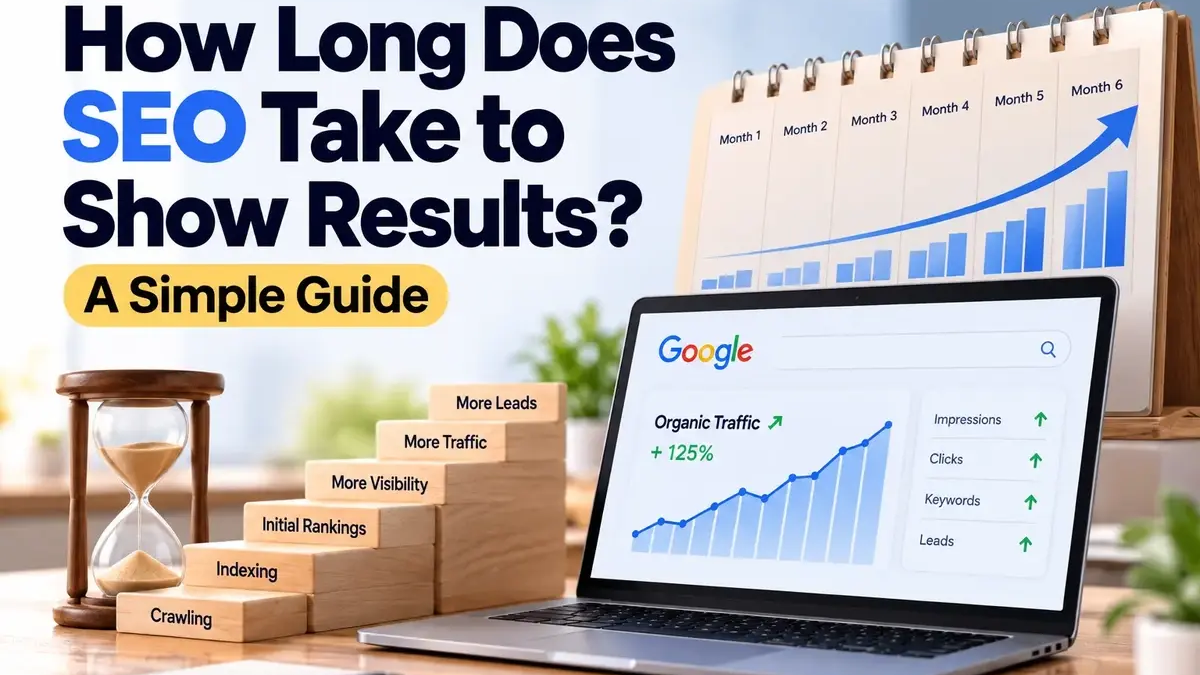
Crawling → Indexing → Initial rankings → More visibility → More clicks → More enquiries
The speed of that process depends on the website and the market.
What Happens During the First Few Weeks?
The first stage is often about understanding and fixing the website.
An SEO team may look at:
- Technical issues
- Website structure
- Indexing
- Page titles
- Meta descriptions
- Headings
- Internal links
- Existing content
- Keyword targeting
- Local SEO information
For a new website, Google may first need to discover and crawl the pages.
Google says that new pages can take anywhere from a day or two to a few weeks to be crawled and indexed, depending on various factors.
That is why expecting strong rankings immediately after launching a website is usually unrealistic.
What Happens After the Website Is Indexed?
Being indexed and ranking well are two different things.
This is important.
Indexed means Google has included the page in its index.
Ranking means where that page appears for a particular search.
Your page can be indexed and still appear very low in the results.
Google specifically recommends checking whether a page is indexed before assuming it has a ranking problem.
For example, you can search:
site:yourdomain.com
This can help you see whether Google has indexed pages from your website. Google recommends this as a basic check.
Why Do Some Websites Show Results Faster?
Several factors can affect the speed of SEO progress.
1. Website Age and History
A completely new website has little search history.
An established website may already have indexed pages, backlinks, brand searches, content and other signals.
That does not mean an old website will automatically rank better, but the starting point can be different.
2. Competition
Ranking for a highly competitive search is different from ranking for a very specific search.
For example:
“digital marketing agency”
is much broader than:
“Google Ads agency for dental clinics in Noida.”
The second search may have a more specific audience and a different competitive environment.
3. Website Quality
A technically weak website can create SEO problems.
Issues with crawling, indexing, page structure, mobile usability or content can make optimisation harder.
Google’s developer guidance recommends making a website secure, fast, accessible and functional across devices.
4. Content Quality
Publishing content is not the same as publishing useful content.
Google recommends people-first content that genuinely helps users rather than content created mainly to manipulate search rankings.
This means your pages should answer real questions and provide useful information.
5. Search Intent
A page can target the right words but still fail to satisfy what users are looking for.
For example, someone searching:
“how to choose a digital marketing agency”
is looking for guidance.
Someone searching:
“digital marketing agency in Gurgaon”
may be much closer to contacting a business.
The content and landing page should match the intent behind the search.
Can SEO Show Results in 30 Days?
It can show early signs of progress, but that does not mean every website will achieve major traffic or lead growth within 30 days.
You may see:
- Pages being indexed
- Improvements for some keywords
- More impressions
- Better click-through rates
- More visibility for long-tail searches
These are useful signals.
But strong business results usually require more than a few weeks.
The important question is not:
“Did I reach page one in 30 days?”
It is:
“Is the website moving in the right direction?”
What Should You Measure?
Many businesses look only at keyword rankings.
That is not enough.
SEO progress can be measured through:
Search impressions
Organic clicks
Relevant keywords
Landing-page traffic
Engagement
Enquiries
Phone calls
Form submissions
Qualified leads
Google Search Console can help website owners understand how their pages perform in Google Search.
The ultimate goal is not simply more rankings.
The goal is more relevant visibility and useful business outcomes.
Why SEO Results Can Go Up and Down
SEO is not a straight line.
One month may show strong improvement.
The next month may be slower.
Rankings can change because of:
- Search-engine updates
- New competitors
- Content changes
- Technical problems
- Changes in search behaviour
- Changes to search results
That is normal.
SEO should be viewed as an ongoing process rather than a one-time task.
What If Your Website Has Been Doing SEO for Months but Nothing Is Happening?
This is when you should stop and diagnose the problem.
Ask:
Is the website actually indexed?
Are we targeting the right searches?
Does the content match search intent?
Are important technical problems still present?
Are competitors offering more useful information?
Is the website building relevant authority?
Are we measuring the right results?
If the answer to several of these questions is “no”, simply waiting longer may not solve the problem.
SEO Is Not About Waiting
A common misunderstanding is that SEO means:
“Do some work and wait six months.”
That is not a good way to think about it.
A strong SEO process should continuously:
Research → Optimise → Publish → Measure → Improve
Each stage should give you information that helps with the next stage.
Final Thoughts
So, how long does SEO take?
There is no fixed answer.
A website may show early signs of progress within weeks, while meaningful growth can take several months or longer depending on competition, website condition, content, authority and the work being implemented.
The best way to judge SEO is not by one promise like:
“You will rank in 90 days.”
Instead, look for steady progress in visibility, relevant traffic and business actions.
Good SEO is not about chasing rankings.
It is about helping the right people find the right page at the right time.
Frequently Asked Questions
How long does SEO take to work?
SEO timelines vary. Many businesses see measurable progress over several months, but the exact timeline depends on the website, competition, content and other factors.
Can SEO work in one month?
You may see early changes in indexing, impressions or rankings, but strong organic growth usually takes longer.
Why is my SEO not showing results?
Possible reasons include technical issues, weak content, wrong search intent, high competition, poor website structure or a lack of relevant authority.
Does a new website take longer to rank?
Often, yes. A new site first needs to be discovered, crawled and indexed, and then its pages need to compete with existing results.
Can anyone guarantee SEO results?
Specific rankings or guaranteed business outcomes should be treated carefully. Google states that there are no secrets that automatically make a site rank first.